Rethink What You Know About Core Aeration & Dethatching.
MicroCore Aeration • EcoDethatching
For decades, homeowners have relied on core aeration and dethatching to improve lawn health. While those services have benefited countless lawns over the years, advances in biological soil science have introduced a more comprehensive approach to improving the soil beneath your lawn.
University Tested. Michigan Proven.
The biological technologies behind Turf & Soil Reborn have been evaluated at four leading horticultural universities, including Michigan State University. The research demonstrated 100% treatment coverage throughout the treated lawn and root zone, up to a 20% reduction in irrigation requirements, zero downtime, no risk to irrigation systems, underground utilities, or invisible pet fences, and significantly greater overall improvements than traditional mechanical aeration and dethatching methods.
Unlike traditional core aeration—or products marketed as liquid or bio aeration—Turf & Soil Reborn uses beneficial living microorganisms to biologically improve soil structure, naturally reduce excess thatch, and restore healthier conditions throughout the root zone.
It’s not simply another alternative to core aeration and dethatching—it’s a completely different approach to improving soil health.

Why Healthy Lawns Begin Below the Surface
Most homeowners judge their lawn by what they can see. Thin grass. Brown patches. Weeds. Poor color. Standing water after rain. Areas that never seem to improve, no matter how much fertilizer or water they receive.
Those are all symptoms.
The real problem is often hidden beneath the surface.
Healthy lawns depend on healthy soil. When the soil begins losing its structure and biological activity, even the best lawn care practices become less effective. Water struggles to move into the root zone, oxygen becomes limited, nutrients are harder for roots to absorb, and the turf gradually loses the strong foundation it needs to thrive.
Healthy lawns begin with healthy soil. Two of the greatest threats to that foundation are soil compaction and excessive thatch.
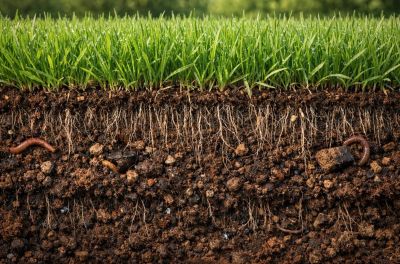
Soil Compaction
Healthy soil isn’t solid.
Soil is made up of millions of tiny pore spaces that allow oxygen, water, and nutrients to move freely throughout the root zone while giving roots the room they need to expand. Over time, those spaces slowly disappear.
Michigan’s heavy clay soils, repeated mower traffic, foot traffic, construction, and our annual freeze-thaw cycles gradually compress the soil until it becomes dense and difficult for roots to penetrate.
As compaction increases:
- Water begins running off instead of soaking in.
- Fertilizer becomes less effective.
- Roots remain shallow.
- Turf becomes more susceptible to drought, heat, and disease.
- Grass gradually becomes thinner and weaker.
Most homeowners never realize it’s happening until the lawn begins showing obvious signs of decline.
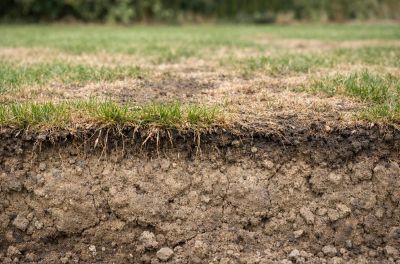
Excessive Thatch
Why This Matters
Thatch is the layer of dead stems, roots, and organic material that naturally forms between the grass blades and the soil. A small amount of thatch is healthy.Too much is not.
As thatch continues building, it begins acting like a barrier between the turf and the soil below. Instead of moving freely into the root zone, water, oxygen, and nutrients become trapped above the soil where they’re far less effective. Heavy thatch can also create favorable conditions for insect activity, disease development, shallow rooting, and poor seed establishment.
Many homeowners continue watering and fertilizing without realizing the real problem isn’t above the ground—it’s the layer separating the grass from the soil beneath it.


MicroCORE AERATION
Unlike core aeration, our MicroCORE AERATION creates thousands of microscopic channels throughout the root zone that improve oxygen exchange, water movement, and nutrient availability.
EcoDETHATCHING
Beneficial microorganisms naturally break down excess thatch and recycle valuable organic matter back into the soil ecosystem—without tearing up your lawn and with no recovery time.
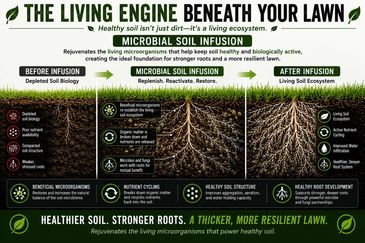
Microbial Soil Infusion
PhD-Formulated Nutrition
PhD-Formulated Nutrition
Rejuvenates the beneficial microorganisms that keep soil healthy and biologically active, helping restore the living ecosystem that supports long-term turf health.
PhD-Formulated Nutrition
PhD-Formulated Nutrition
PhD-Formulated Nutrition
Supplies carefully balanced macro- and micronutrients selected to nourish both the soil ecosystem and the turf, supporting healthier roots, stronger grass, and long-term soil performance.

Turf Specialists
Schedule a Lawn Evaluation or Request a Quote